
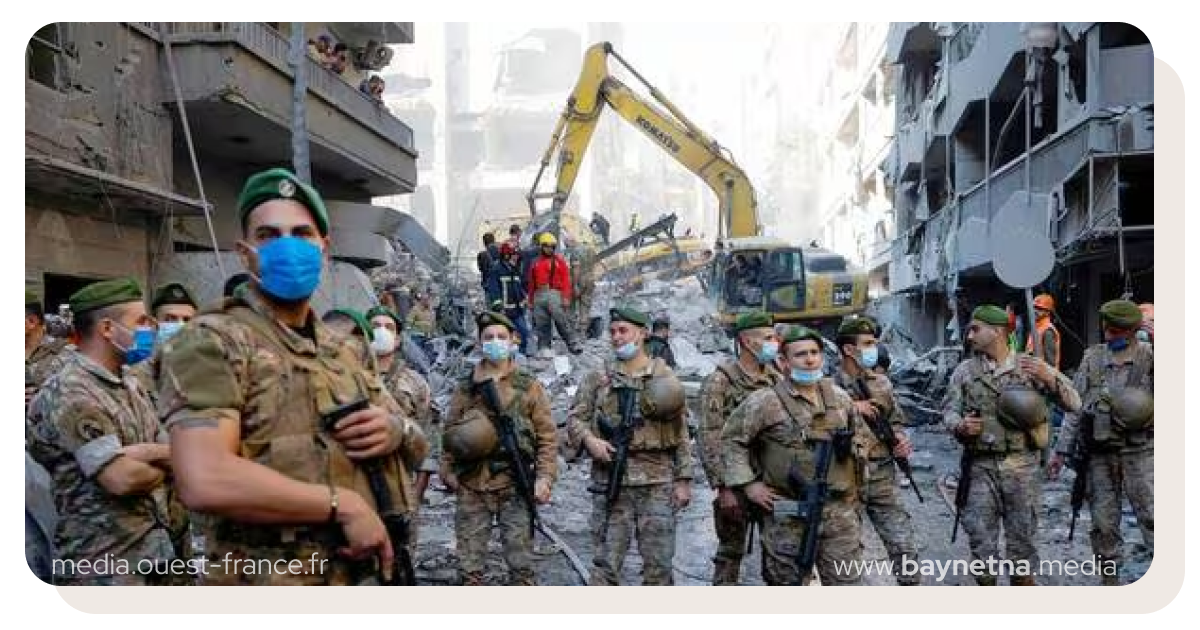
As Hezbollah faces a series of military, political, and logistical challenges, our armed forces are increasing their visibility and control over the southern part of our country. Between Israeli strikes, internal pressures, discoveries of arms caches, and limitations on Iranian support, the operational capabilities of the political-military organization seem to be undergoing adjustments. This dynamic is part of a broader shift in the balance of power, where the role of the State in the security management of the South tends to evolve.
Internal pressures on Hezbollah
Actions of our armed forces to control weapons
Since the ceasefire in South Lebanon came into effect at the end of November 2024, our Lebanese army has positioned itself at the heart of a state operation aimed at regaining the monopoly on weapons throughout the entire territory.
This dynamic is part of the implementation of the plan titled “Shield of the Homeland.” This decision responds to internal and international pressures calling for the disarmament of non-state armed groups, primarily Hezbollah, and the restoration of Lebanese state sovereignty.
The Lebanese government officially tasked the army in early August 2025 with preparing a plan to ensure the state’s monopoly on weapons, including the disarmament of non-state armed groups (including Hezbollah) by the end of the year. This decision was made following a meeting of the Council of Ministers in early August.
This plan was structured in five phases, the first of which began in September 2025, it was presented and then approved by our government.
In the days following its launch, the first phase began in the area south of the Litani River. The Lebanese army says it has discovered 177 tunnels since the launch, closed 11 crossing points along the Litani River and seized 566 rocket launchers. Brigadier General Nicolas Tabet, commander of the South Lebanon region, claims that the army has carried out 300,011 military missions in the southern Litani region since the launch of the plan.
Economic and social repercussions on the party
Beyond the military context, Hezbollah operates in an environment marked by increased financial constraints, which could affect its operational capabilities, both military and social and political.
The economic crisis that has hit our country since 2019 has drastically reduced public and private revenues, affecting all of the country’s financial circuits, including those on which various political formations and organizations traditionally relied.
The Lebanese banking sector has collapsed, leading to a severe contraction of the national economy and a double pressure on all entities operating outside the regulated financial system, including financial structures associated with Hezbollah.
In this context, the Central Bank of Lebanon (BDL) has issued directives prohibiting licensed financial institutions from dealing with unlicensed entities, including the Hezbollah-affiliated financial institution, Al-Qard Al-Hassan. This further restricts these entities’ access to formal banking services and complicates their routine financial operations.
This financial fragility is not limited to internal or structural constraints. It is part of a broader framework where economic, regulatory and external factors contribute to redefining the environment in which the movement operates.
External pressures on Hezbollah
Interventions et frappes israéliennes
Despite the ceasefire coming into effect at the end of November 2024, the Israeli army continued its targeted operations against Hezbollah-affiliated structures and personnel in southern Lebanon. According to Israeli authorities, these strikes are part of an ongoing pressure strategy aimed at limiting the movement’s military capabilities and preventing any rebuilding of its logistics and infrastructure after the 2023-2024 conflict.
Thus, on December 14, 2025, the Israeli army stated that it had killed at least three Hezbollah members during air operations in South Lebanon, including in several localities close to the border with Israel, according to military statements published by the Israeli forces.
This series of strikes occurs amid intensified operations, with Israel regularly announcing attacks against what it calls ‘weapons sites’ or ‘military activity centers’ of Hezbollah despite the ongoing ceasefire.
Between December 8 and 14, 2025, the Israeli army conducted airstrikes, artillery attacks, and drone strikes in over 36 Lebanese localities south of the Litani.
Iran’s Support and the Limits of This Aid
Iranian support for Hezbollah has been a central element of the relationship between the two actors since the movement’s inception in the 1980s. Historically, this support has taken various forms, including military, financial, logistical, and political. Iranian authorities continue to portray Hezbollah as a strategic ally in the Middle East, despite regional tensions and international pressure. Iranian officials have reaffirmed their commitment to the movement, describing it as a “pillar of resistance” against Israel, in accordance with the directives of the Supreme Leader, Ayatollah Ali Khamenei.
However, according to several analyses, this support is now taking place within a context of increased constraints. Iran itself is experiencing persistent economic difficulties, marked by international sanctions, high inflation, and structural budget imbalances, which affect its ability to sustainably support its regional partners.
On a logistical and political level, Iranian support faces obstacles. With the evolving regional geopolitical context, including the overthrow of the Syrian regime, traditional land routes for supplying aid to Lebanon have been disrupted. These changes have reportedly led to an adaptation of support methods, relying on more indirect and complex channels.
This combination of economic, logistical, and diplomatic factors could limit the scope of Iranian support in the face of Israeli military pressure, initiatives to strengthen the authority of the Lebanese state, and the financial constraints weighing on Hezbollah. These limitations could ultimately reduce the movement’s operational capabilities.
Weapons, Tunnels, and Bunkers Discovered
Beyond the airstrikes, operations conducted by the United Nations Interim Force in Lebanon (UNIFIL) and our armed forces have led to the discovery of weapons caches and underground networks in several areas of southern Lebanon, reducing Hezbollah’s operational capabilities. Since October 2024, more than 300 weapons caches have been identified and transferred to our forces for processing. Multiple networks of tunnels and bunkers have been discovered in Tayr Harfa, Zibqine, and Naqoura, containing underground shelters, artillery pieces, and hundreds of missiles, according to official sources.
These operations reflect a shift in the security balance of power, marked by a strengthening of government authority and an increased presence of our armed forces in areas where security management previously relied on other actors.
Our Armed Forces: A Central Player in National Security
Diplomatic and Media Visibility
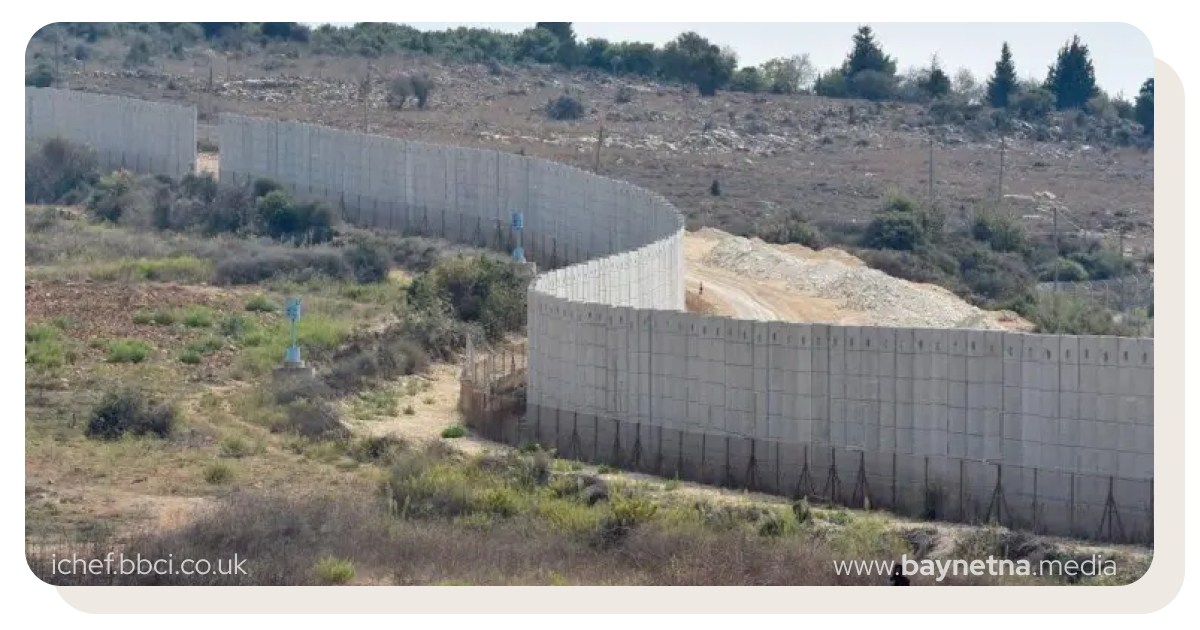
Our Lebanese armed forces have actively sought to enhance the diplomatic visibility of their actions. In December 2025, the army organized a field visit for a group of foreign diplomats and military officers, including the ambassadors of the United States and Saudi Arabia, along the Lebanese-Israeli border. This initiative aimed to demonstrate the concrete measures implemented as part of the disarmament of non-state armed groups, particularly the implementation of the first phase of the “Homeland Shield” plan south of the Litani River, as well as the army’s central role in stabilizing this area.
This type of event is not merely symbolic. It represents a strong message to the international community: that of an army assuming responsibility for national security by collaborating with international actors, while demonstrating operational transparency in the face of criticism and media pressure. Thus, beyond the usual press releases, these visits offer foreign observers a direct immersion into the efforts deployed on the ground, thereby providing diplomatic support for Lebanon’s claims to sovereignty and institutional strengthening.
Deployment and Territorial Control
Operationally, our armed forces have increased their presence on the ground, particularly in the south of the country. The objective is no longer simply to monitor, but to ensure an active and continuous presence in sensitive areas to limit the risks of Hezbollah rearming or rebuilding its military capabilities in the affected regions. This translates into regular patrols and systematic checks of roads near the Blue Line.
Furthermore, these activities are conducted in coordination with international observers. Their participation is generally presented by the Lebanese authorities as a factor contributing to the credibility and international acceptability of operations carried out on Lebanese territory.
Towards Security Rebalancing in the South
All of these developments highlight a gradual transformation of security dynamics in the south of the country. Hezbollah, a central player in the regional security equation for several decades, now operates in an environment marked by multiple constraints, both internal and external, which influence its room for maneuver. These factors include the persistence of military tensions with Israel, economic and financial pressures, the shifting regional balance of power, and the increased redeployment of the Lebanese armed forces in certain sensitive areas.
This configuration reflects a gradual rebalancing of roles between state and non-state actors, in a context where the Lebanese state seeks to strengthen its presence and operational capabilities throughout its territory. For the first time in years, a credible state authority is emerging in areas long dominated by a non-state armed group.
Sources:
- https://www-newarab-com.translate.goog/news/lebanese-army-shows-diplomats-efforts-disarm-hezbollah?
- https://yalibnan-com.translate.goog/2025/09/06/lebanons-homeland-shield-to-disarm-hezbollah-begins-in-south-of-litani-and-includes-5-phases-minister/
- https://www-newarab-com.translate.goog/news/lebanons-central-bank-bans-dealings-hezbollah-finance-arm?
- https://www.aa.com.tr/en/middle-east/3-killed-in-israeli-strikes-in-southern-lebanon-despite-ceasefire/
- https://www.fdd.org/analysis/2025/12/17/israeli-operations-in-lebanon-against-hezbollah-december-8-14-2025/
- https://www-aa-com-tr.translate.goog/en/middle-east/iran-reaffirms-support-for-hezbollah-amid-disarmament-push/3652853?