
Today, the Lebanese economy is sending us highly contradictory signals. On one hand, we see rising figures; on the other, we feel a daily reality that weighs heavily on the shoulders of young professionals. To understand where our country is headed, we must look beyond official rhetoric and examine the most concrete barometer of our land: Lebanese concrete.
A Necessary Look at Our Foundations
The construction sector has always been the lung of the Lebanese system. When the cement mixers are turning, the whole country seems to breathe. But today, this breathing sometimes resembles a shortness of breath masked by dust. Together, we will decode what lies behind the scaffolding rising from Beirut to Tripoli.
1. A Deceptive Real Estate “Boom” in Lebanon
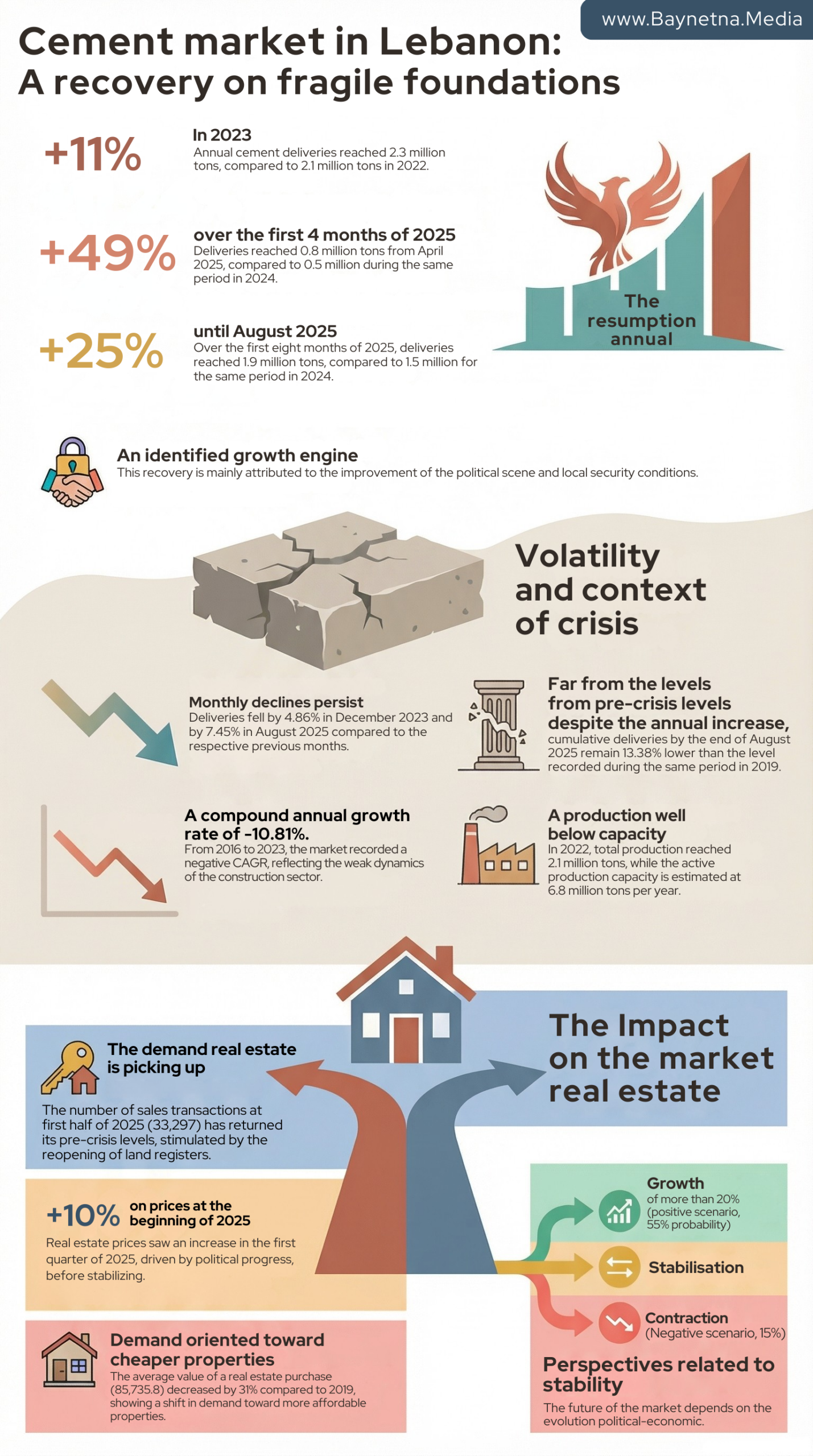
On the surface, the Lebanese real estate market appears to be regaining its spring colors. Statistics show a spectacular leap in transactions during the first half of 2025. Volume reached an impressive 33,297 registered operations—more than double the 16,390 operations seen during the same period in 2024.
This volume even exceeds what we observed before the 2019 financial earthquake. To a distant observer, it looks like a miraculous rebirth. Yet, for those of us living here, the reading is quite different. This figure hides a major paradox that we must analyze with lucidity.
The Sharp Decline in Average Values
The average value of a real estate transaction has plummeted. It now stands at approximately $85,735. This represents a massive 40.6% drop compared to 2022. This dynamic does not lie about the real situation of Lebanese families.
The market is undergoing a clear shift toward much less expensive properties. This is a symptom of purchasing power totally eroded by inflation. Our middle class is experiencing a downgrade that affects us all closely. What we are seeing is not a recovery, but a form of liquidation.
A Cash Economy Without Credit
Households are still deprived of normal access to their bank savings. Consequently, they are transforming their remaining assets into liquidity, buying small properties as the only accessible safe haven. In this cash economy, mortgage credit has become a distant memory.
2. Cement as a Barometer of Lebanon’s Fragile Recovery
Another indicator catches our attention in recent reports: cement deliveries are often considered the pulse of national vitality. During the first four months of 2025, these deliveries increased by 49% compared to the same period in 2024.
However, we must place this rebound in its true context. This performance starts from an extremely low level. After years of collapse, the slightest jump appears gigantic. The annual growth rate of deliveries was still negative in the previous period.
Consumption Still Far From Its Peaks
To put things in perspective, let’s look at global volumes. Cement consumption in 2022 stagnated at 2.12 million tons—a paltry figure compared to the 5 million tons recorded in 2015. The current recovery, therefore, resembles a simple technical correction.
This increase likely does not finance major structural projects for the future. Instead, it corresponds to urgent renovations or modest constructions. This aligns perfectly with the demand for cheaper real estate. Lebanon is patching its wounds more than it is building its future.
3. Industrial Potential and Lebanese Exports
The gap between what we could achieve and reality is striking. Lebanon possesses significant active cement production capacity, estimated at 6.85 million tons per year. Yet, our factories are currently running at a slow pace.
An Underutilized Industrial Infrastructure
The infrastructure is there, but it remains massively underused. This gap is a tangible illustration of the depth of our crisis. It is the sign of a state that can no longer provide vital energy.
To break this deadlock, we must bet on Lebanese exports. A strong cement industry is the bedrock of our entire logistics chain. Without solid infrastructure, we cannot guarantee the transport of our goods, which directly affects our ability to conquer foreign markets.
Supporting Agricultural Product Exports
The link between concrete and the dinner plate is more direct than one might think. To boost the export of agricultural products, we need warehouses and roads. The construction sector must serve as a logistical base for our farmers, allowing Lebanese exports to regain their former glory.
The export of agricultural products is an opportunity for our diaspora. Our products are loved worldwide. But without an efficient processing industry, we lose added value. Concrete must be used to build the factories of tomorrow, not just empty apartments.
4. An Economy Suspended by Political Decisions in Lebanon
A recurring theme runs through all the economic reports we consult: the slightest improvement is systematically linked to the political context. This total dependency is the most worrying factor for our shared future. The destiny of Lebanon seems to be written in polling stations more than in factories.
Bank Audi’s Prospective Scenarios
Bank Audi’s latest report for the next twelve months is very clear. It envisions several trajectories for our national economy. A positive scenario predicts a 20% increase in real estate prices—a prospect that could restore hope to many investors.
In Lebanon’s economic context, a price increase is deemed “positive” for investors and banks because it signals the end of the “fire sale” (liquidation) period. It restores the value of assets used as bank collateral, strengthens confidence in real estate as a safe haven, and indicates a return in demand, which is essential for stabilizing the financial sector.
A Probability Conditioned by Reforms
However, the 55% probability assigned to this scenario is fragile. It relies entirely on major and courageous political progress. In its report, Bank Audi does not just predict the future; it establishes probabilities based on different possible scenarios.
The State must imperatively assert its primacy over all armed forces. It is urgent to ratify the law on the financial gap to protect depositors.
Our reasoning is as follows: No total sovereignty = No stability = No massive investment = Failure of the 55% recovery scenario. For an economy to function, the State must be the sole master on board. If weapons circulate outside State control, the risk of internal conflict or war is judged “high” by international markets.
The IMF Agreement Remains the Key
Finally, concluding an agreement with the IMF remains indispensable. Without these reforms, economic fundamentals remain secondary to uncertainties. This ambiguity makes any long-term investment extremely precarious. We are navigating by sight in a fog that is struggling to clear.
Lebanon’s economy is not recovering yet; it is transforming through pain. Behind the bustle of construction sites lies a reality of subsistence. we are no longer managing to sell, and asset values continue to decline. Furthermore, we are building, but without a global vision for our youth.
Yet, the potential for Lebanese exports remains immense and very real. The dynamism of our entrepreneurs can still save the export of agricultural products. Lebanon stands at a crossroads between sustainable reconstruction and a mere reprieve. It is up to us, the workers and active citizens, to turn this concrete into a foundation for tomorrow.


